


Want to hear more?
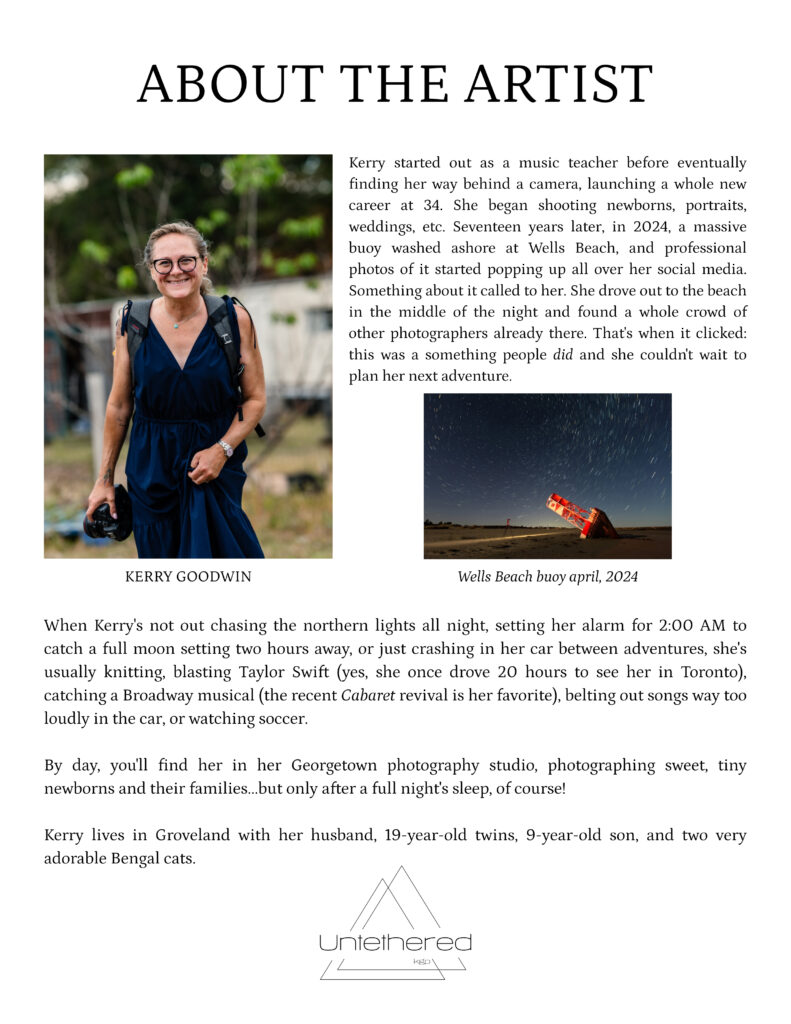
It actually started with a giant buoy. In 2024 this massive buoy washed up on Wells Beach, and photos of it were everywhere. I couldn’t stop looking at them. So I went out to see it myself, around midnight, walking this long dark path alone like a fool. When I got close I realized I wasn’t alone at all. There was a whole crew of photographers already out there. After that,I started following guys like Gal Steinberg, Jeremy Noyse, Eric Storm, Erik Fraser, and Corey Cain and was so blown away by what they were creating that I just had to figure out how to do it myself.
Before the shoot, it’s basically a running bucket list of locations and conditions, all written down. Then you wait, because you can’t exactly negotiate with the weather. I follow every Aurora Facebook group I can find and Kirk Giglio taught me how to read some of the data though I’m still far from an expert. Sunrises and sunsets live and die by the specific clouds in the sky, which I’m still trying to crack. Milky Way and Aurora shots mean chasing dark skies, so a lot of driving. Full moon shots need an app to line the moon up with the right landmark. And don’t even get me started on birds. During the shoot, I go where I need to go. Sometimes that’s leaving at midnight, driving three hours, getting the shot, and driving three hours back in time to get my son to school. Other times it’s a couple days on the road, sleeping in the car, touring the Maine coast all the way up to Campobello Island in Canada. After the shoot, I can’t wait to pull the images off the camera. I keep the editing light. Just a little exposure, a little saturation, cleaning up noise if there is any. Star trails are the one exception. Those are an hour or more of long exposures blended together to show the stars actually moving across the sky.
Oh, gas and road snacks are a must.
Honestly? It’s exhilarating. I love being out there alone in the middle of nowhere. When the Aurora lights up in front of you, the adrenaline just pumps. Sometimes I get so excited I completely go blank on how to choose the right settings. Landing a bucket list shot is addictive and keeps you coming back for more.
But there’s also a lot of “well, that didn’t work.” Driving out for a moonrise and finding something blocking the view. Getting an Aurora alert, driving two hours to dark sky, and you get nothing. That part never stops stinging a little. And sometimes getting the shot means questionable life choices like climbing slick rocks at the ocean, scaling something like 40 stories up a cliff, standing on the roof of my car. Whatever it takes.
I want to “wow” them, honestly. I’d shoot these even if nobody ever saw them. I just love the process that much, but I still want people to feel something when they look at them. One time someone bought a shot of Marshall Point Lighthouse, and when I told her the story behind that day (which was a sad one) she actually cried. Later, someone else looked at that exact same photo, knowing nothing about the story, and said,” this one feels sad.” That connection floored me. Other times it’s simpler. Someone sees a spot they grew up going to and says “oh, this brings back so many memories.” Being able to do that with a photograph is the best part of this whole thing.